
New Discoveries: Revolutionary Upcycle: The Kentucky Historical Society’s “Lafayette Dress”
Jennifer Downs
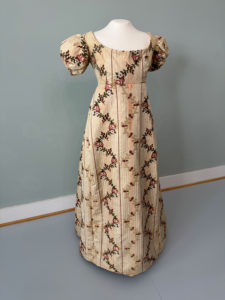
In May 1825, in honor of the upcoming fiftieth anniversary of the signing of the Declaration of Independence, the Marquis de Lafayette traveled through Kentucky during his illustrious American Farewell Tour (Figure 1). The venerable French celebrity, who was the last surviving major general of the American Continental Army, symbolized liberty and idealism and was fêted with parades and parties commemorating his heroic contributions to the American Revolution. On 14 May, between stops in Louisville on 12 May and Lexington on 15 May, he was notably celebrated in Frankfort, the seat of state government. In the capital city, a grand procession on St. Clair Street passed the public square, where “ladies welcomed the General from the windows by scattering roses and waving handkerchiefs.”[1] Lafayette’s secretary André-Nicolas Levasseur, who accompanied him, wrote that “…the entertainments given on this occasion by the inhabitants of the town, to which were joined those of … Continued
“Fire away, then.” Invasion, Silver, and Memory at Monticello
Emilie Johnson
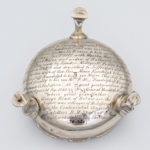
On the morning of 4 June 1781, the American Revolution came thundering up the hillside to Monticello’s doorstep. The hooves of a mounted group of British Dragoons, many of whom were Loyalist soldiers from Pennsylvania and New York, pounded up the dirt roads, led by Captain Kenneth McLeod. His mission: to capture Virginia Governor Thomas Jefferson and other members of the Virginia legislature. He nearly succeeded. Thomas Jefferson carefully recorded his memories of the events of June 1781. According to Jefferson, the Virginia General Assembly had reconvened in Charlottesville in May due to aggressive British military activity around Richmond. Jefferson was in residence at Monticello with his wife and two daughters. Speaker of the House Benjamin Harrison, Speaker of the Senate Archibald Cary, and legislator Thomas Nelson Jr., accompanied by their enslaved attendants, also lodged at Monticello. None of them knew that Lieutenant Colonel Banastre Tarleton, commander of the British … Continued
What was James Read Reading? Case Study of a Bibliophile on the Eve of the American Revolution
Emelia Lehmann
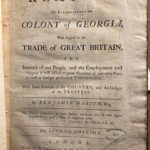
Pennsylvania, 1770. One crisp fall morning, James Read strolled into his study at his house in Reading. Refreshed from a swim in the Schuylkill River (his habit when the weather was fine), he picked up a thin package that had recently arrived from Philadelphia. Carefully unwrapping the brown paper, he held a small book with paper-on-board bindings. He sat down at his desk and pored over its pages, immersed in the text. His excitement grew and he grabbed a pencil, underlining phrases as he went and writing in the margins: silk. SILK. SILK. As the morning grew bright and the household buzzed around him, he sat back in his chair with satisfaction. He closed the book, then reopened it and flipped to the title page. He reached across his desk for his quill, dipped it in ink, and wrote in the corner of the page James Read’s of Reading on … Continued
New Discoveries: Following Through: Zechariah Johnston’s Side Chair and its Commemorative Afterlives in Rockbridge County, Virginia
Ella Nowicki
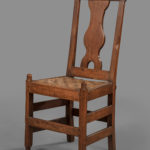
In 1970, the Museum of Early Southern Decorative Arts (MESDA) acquired a walnut side chair (Figure 1) with a single-sentence provenance: “Original property of Zachariah Johnstone—brought by Zachariah Johnstone from Augusta Co., Virginia, to his new house, Providence Hill, in Stonebridge [sic] County near Lexington.”[1] This line is more than a lead for mapping the chair’s life onto Johnston’s biography. It suggests how, for decades, the chair has been understood as both a piece of eighteenth-century furniture and an object of memory, its meaning distilled into its association with a single prominent owner. Zechariah Johnston, as he more often spelled his name, was born to Scotch-Irish parents and was baptized in 1742 in Augusta County, Virginia.[2] Today he is best known as a Presbyterian advocate for religious freedom in the Virginia House of Delegates.[3] He is also remembered as a Revolutionary War militia captain and a decisive pro-Constitution voice at … Continued
2026 Editor’s Welcome
Kim May
This special issue of the MESDA Journal explores the American Founding through the objects people made, used, and remembered, and through the communities that gave those things meaning. The essays gathered here remind us that the Revolution unfolded in parlors and workshops, in taverns and studies, and within the intimate decisions of families and communities that navigated war, preserved traditions, and interpreted the world around them. Three full-length articles will anchor this year’s volume. Emelia Lehman’s study of James Read’s annotated copy of Reasons for Establishing the Colony of Georgia explores how a single book linked a Pennsylvania lawyer to transatlantic networks of print, intellectual exchange, and the hopeful—if fragile—dream of an American silk industry. Her close reading of Read’s marginalia, written on the eve of revolution, sheds light on northern interests in Georgia’s early silk experiments. Martha Hartley’s article turns to Wachovia, tracing how the Moravians in Salem, Bethabara, … Continued
© 2026 Museum of Early Southern Decorative Arts